
What Is High-Intensity Laser Therapy?
High-intensity laser therapy (HILT) is an FDA-cleared treatment option that is unique in its ability to penetrate through bone, soft tissue, and muscle to deliver healing light energy to the cells of the body. HILT can reduce pain, minimize swelling, soften scar tissue, and reset the chronic pain cycle – all while healing damaged tissues at the cellular level.
A Different Treatment Approach
There are a variety of options for treating acute and chronic pain. Pain medications and injections may provide temporary comfort, but they don’t do anything to address the root cause of the pain – once the medication wears off, the pain returns. They can also be accompanied by serious side effects including other health problems, depression, and addiction. Surgery is expensive, carries its own set of major risks, recovery can last for weeks or months, and the success rates are not as high as you might expect.
High-Intensity Laser Therapy Is Different
Our high-intensity laser therapy is a non-invasive, drug-free approach that treats the underlying cause of pain by actually repairing damaged cells. The laser used at our clinic is a Class IV therapeutic laser that was co-developed by our own Dr. Curt Draeger, DC, DACBOH, CCST, drawing from his experiences treating professional athletes and chronic pain sufferers. These lasers are multiple times stronger than other lasers, reach deeper into the cellular tissue, and treat surrounding tissues to provide better outcomes and longer-lasting results for our patients.
Conditions
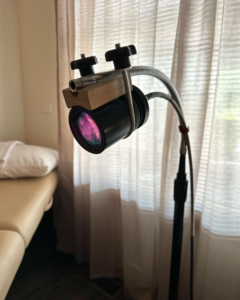
Many conditions benefit from high-intensity laser therapy:
- Low back pain
- Arthritis
- Neck pain
- Neuropathy
- Shoulder pain
- Hip pain
- Knee pain
- Sciatica
- Headaches
- Plantar fasciitis
- Tendonitis
- Tennis elbow
- Bursitis
- Carpal tunnel syndrome
Is HILT Safe?
Yes! Our high-intensity laser therapy has been cleared by the FDA for treating pain. It has been used in Europe since the 1970s and has been trusted by elite athletes around the world to accelerate recovery. Laser therapy has no known side effects when used by a properly trained professional.
How Does HILT Work?
The light energy from the laser stimulates healing within your body through a series of biological changes at the cellular level.
- Speeds tissue repair and cell growth
- HILT accelerates cellular reproduction and growth by starting DNA and RNA repairs inside of the cells. Cells of cartilage bones, tendons, ligaments, nerves, and muscles are repaired faster as a result of exposure to the laser.
- Softens scar tissue
- HILT softens existing scar tissue and reduces the formation of new scar tissue following tissue damage. This is important because after an injury, the body heals with a tight, fibrous network of scar tissue. Scar tissue is less elastic, has poor circulation, is sensitive to pain, is weaker, and is more prone to injury. HILT can soften scar tissue so that the doctor can work with the tissue to lengthen the fibers enabling more movement and mobility.
- Relieves pain
- HILT reduces pain by increasing the production of pain-killing chemicals (such as endorphins and enkephalins) from the brain and adrenal gland.
- Resets the chronic pain cycle
- Chronic pain signals are actually memorized in the nerve switching stations in the body called interneurons. For example, pain that is felt in the knee is memorized in the interneurons near the spinal cord. The laser reaches into the interneurons to reset that pain memory.
- Reduces swelling
- HILT provides an anti-inflammatory effect as it causes expansion of blood vessels and activation of the lymphatic drainage system. As a result, there is a reduction in swelling caused by stress, trauma, overuse, or systemic conditions.
- Improves blood flow
- HILT improves vascular activity and increases the formation of new capillaries in damaged tissues. This enables the body to deliver more oxygen and other vital nutrients to the treated area to speed healing.
- Improves nerve function
- HILT accelerates the process of nerve cell regeneration and improves the communication between the nerves and the brain.
Difference Between Low-Level Laser and High-Intensity Laser Therapy
Both lasers are based on the same technology and science, but one is more powerful than the other. Cold lasers (or low-level lasers) are meant to penetrate no more than 1 inch deep into tissue, and are present in almost all chiropractic clinics. The ability to penetrate any amount of depth depends on how high the wattage is for a particular laser and how many cycles it can pulse in a second. Typical cold/low level lasers have a peak power of 500 milliwatts to 15 watts (1000 milliwatts per watt). These smaller lasers may also pulse the beam into the tissue 5-10 times a second. The pulsing of the laser allows for less heat to be distributed into the tissues, so they do not burn. Here lies the problem — if you cannot pulse a laser fast enough, you will not be able to dispute heat at the surface layers and you will cause burns on the skin.
At Midwest Pain Solutions, we pulse the peak power at 10,000 cycles per second, which takes a very sophisticated computer system. This allows us to penetrate to the depth of tissue that is actually damaged. It’s a F1 race car vs. a Toyota Prius, it’s not in the same category.
Contact our office today for more information on high-intensity laser therapy – call (920) 569-2350 or visit www.midwestpainsolutions.com/services/high-intensity-laser-therapy-hilt.
